
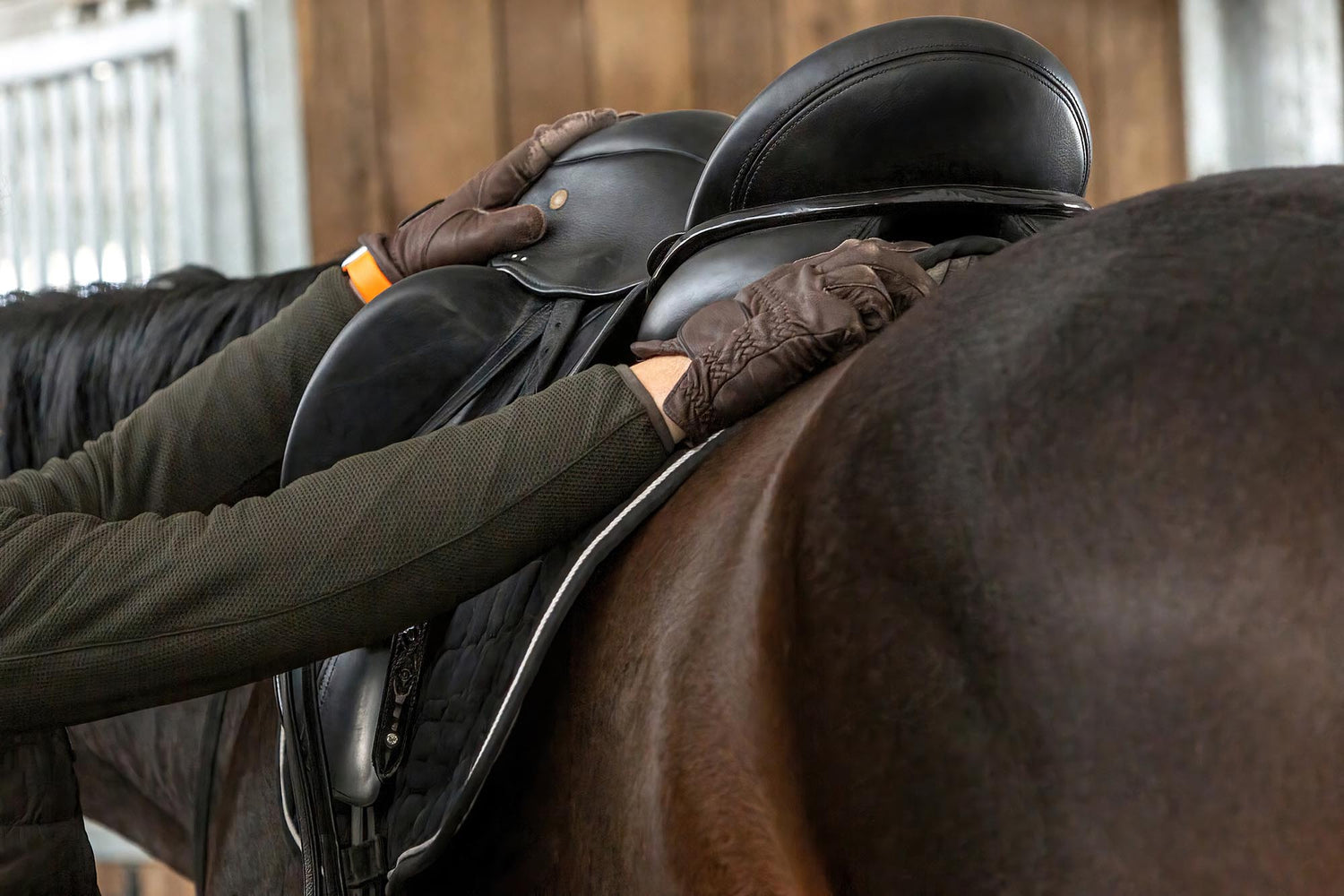
Part of the Saddle Fitting for Horse Owners series. ← Chapter 1: The Anatomy of Saddle Fit
In the previous chapter — The Anatomy of Saddle Fit: What the Horse's Back Tells You — we explored the five parameters that define your horse's unique back landscape.
Now we turn to the other half of the equation: the saddle itself. Understanding what to look for — and how to check it — gives you practical tools to assess any saddle on any horse, whether you are evaluating a saddle you already own, considering a purchase, or simply monitoring fit over time.
These five key parameters of saddle fit will not replace a skilled, independent fitter. What they will do is help you ask better questions, recognize when something is wrong, and decide whether a professional assessment is warranted. Think of them as the first five tools in your saddle fit toolbox.
⚠ Note: Even as an experienced saddle fitter, I encounter situations where all five parameters appear correct on the static horse in the barn aisle — and the horse still objects to the saddle for reasons that only become apparent under saddle. The horse is always the best and final judge.
A quick overview of the five parameters we will cover:
- Spine and wither clearance
- Balance
- Panel contact
- Length
- Stability
1. Spine and Wither Clearance

The foundation of any English saddle is the tree — the rigid internal structure that gives the saddle its shape and distributes the rider's weight across the panels. The tree in combination with the panels and the gullet plate determines two things that are fundamental to saddle fit: the width of the gullet channel, which governs spinal clearance, and the angle of the tree points, which governs wither clearance.
The gullet channel is the channel that runs along the underside of the saddle between the two panels. Its width must match the shape of your horse's back. The front of the saddle — the pommel — is built around the gullet plate, which gives the saddle its tree width.
⚠ Note: A wider gullet channel is not automatically better. The correct channel width is determined by your horse's individual back shape. A channel that is too wide on a roof-shaped horse will cause the saddle to drop onto the spine. This is why perfect fit cannot be assessed by eye alone — it requires an experienced fitter.
Why clearance matters
When a saddle presses on the withers or spine — even slightly — it creates direct pressure on bone and the structures surrounding it. A horse cannot tell you in words that its withers are being pinched. It will tell you in other ways: resistance to being saddled, pinned ears, reluctance to go forward, a shortened stride. Over time, poorly cleared withers cause muscle atrophy, soreness, and lasting damage. Incorrect gullet channel width can lead to swollen vertebrae and worse.
How to check
- Place the saddle on the horse without a pad.
- Girth up the saddle.
- Feel along the front of the saddle as far as you can reach. You are looking for a minimum of two to three fingers of clearance between the saddle and the top of the withers, and along the full length of the gullet channel.
- Use a flashlight to look down the gullet channel if needed — you should be able to see daylight through from pommel to cantle.
- Add a rider and check again. The added weight will lower the saddle, sometimes significantly.
⚠ Note: If there is insufficient clearance at the withers or along the spine, there is typically no adjustment that fixes this. The saddle does not fit. Involve an experienced saddle fitter.
2. Balance

|
| The above saddle is balanced. |
 |
| Even though not girthed, we can see this saddle is pommel-high and too long. |
In English riding, a correctly balanced saddle is one where the deepest point of the seat sits in the center — not tipped forward toward the pommel, and not tipped back toward the cantle. This matters both for the rider and for the horse.
Why balance matters
- A balanced saddle places the rider in a neutral, correct position. An unbalanced saddle forces compensatory posture that makes good riding difficult or impossible.
- When a saddle is balanced, the rider's weight distributes evenly across the full panel surface. When it is unbalanced, weight concentrates in one area — creating pressure points that cause discomfort, soreness, and behavioral resistance.
Balance problems are most often a sign of incorrect tree width. A tree that is too narrow sits high at the pommel, tipping the rider back with legs drifting forward — this is called a pommel-high saddle. A tree that is too wide drops at the pommel, tipping the rider forward — a cantle-high saddle. Both are uncomfortable for horse and rider.
Common misconception: Many riders believe the pommel and cantle must be at exactly the same height. This is not correct. A saddle can have a higher cantle by design, and this does not indicate imbalance. What matters is that the deepest point of the seat is in the center, and that the saddle does not tip noticeably in either direction.
How to check
- With the saddle girthed on the horse, stand directly to the side.
- Look at the deepest point of the seat. Is it in the center, toward the front, or toward the back?
- A simple visual check: place a round chalk stick, marker, golf ball, or other round object in the center of the seat. It should stay relatively still, not roll forward or backward.
- Add a rider and observe from the side: does the rider naturally sit in the center, or are they tipped forward or back? Is it easy for the rider to keep their legs under them?
3. Panel Contact

|
|
The panel of the above saddle does not make contact in the rear of the saddle. |
We touched on panel contact under Balance, but it deserves its own careful attention. The general principle is straightforward: the panels must make full, even contact with the horse's back along their entire length. Any gap, bridge, or area of uneven contact creates a pressure or stability problem.
Why panel contact matters
The numbers here are instructive. A rider weighing around 150 pounds, distributed evenly across a typical English saddle panel surface of approximately 200 square inches, creates roughly 0.75 pounds of pressure per square inch. That is manageable for a healthy horse in good work.
Now consider what happens when the panel does not make even contact. A saddle that bridges — making contact at the front and back but leaving a gap in the middle — concentrates the rider's full weight onto those two contact points. The pressure at those points climbs far above 1.3 pounds per square inch. The result is soreness, behavioral resistance, reluctance to go forward, and in serious cases, lameness.
Bridging explained: A bridging saddle touches the horse's back at the front and rear of the panel but loses contact in the middle — like a bridge spanning a gap. From the outside it may look fine. Only by feeling under the panel can you detect it.
How to check
- With the saddle on the horse without a pad, loosen the girth slightly.
- Starting at the front, slide your flat hand palm-down between the panel and the horse's back. Your other hand rests firmly on the center of the seat to stabilize the saddle.
- Slide your hand gradually toward the back of the panel, feeling for even contact throughout. Any area where you can slide your hand easily indicates a gap.
- If needed, approach from the back of the panel as well, working forward.
- Repeat on both sides. Uneven contact on one side only may indicate a fitting asymmetry or a horse with muscular asymmetry.
⚠ Note: A lack of panel contact cannot be reliably fixed by adding a thicker pad or shims. These are compensations, not solutions. Involve a saddle fitter.
4. Length

|
|
The above saddle is too long for this horse. |
Horses were not designed to carry riders. They are extraordinarily generous partners who accommodate us willingly — but their anatomy has limits, and one of the clearest limits involves saddle length.
The weight-bearing area of the horse's back extends from behind the rear edge of the shoulder blade to T18 — the last thoracic vertebra, which is the last vertebra with a rib attached. Beyond T18, the lumbar vertebrae begin. The lumbar region lacks the lateral support of the rib cage, making it structurally vulnerable. The thoracolumbar junction — the joint between the last thoracic and first lumbar vertebra — is critical for bending, rounding, and stepping under. Loading it with saddle weight shuts down this flexibility and causes pain.

Why length matters
A saddle cannot be too short for a horse. But a saddle that extends beyond T18 causes compressive loading on the weakest part of the horse's spinal bridge. The consequences range from stiffness and resistance to serious soreness. In severe cases I have seen horses so uncomfortable from an over-long saddle that they were unable to reach the ground to graze.
This is not a rare or extreme scenario. Many horses are ridden in saddles that are marginally too long without their owners knowing it.
How to check
- Remove the saddle from the horse.
- Place your hand on the horse's last rib and follow it upward toward the spine. The last rib curves — follow the curve, not a straight line upward.
- Mark the point where the last rib meets the spine clearly with chalk. Draw a short perpendicular line down onto the ribcage so it is visible.
- Place the saddle back on the horse and observe where the chalk line falls in relation to the rear end of the saddle panel.
- The panel should end at or before the chalk line. If the panel extends beyond it, the saddle is too long.
⚠ Note: If your saddle is too long for your horse, involve an experienced saddle fitter. A shorter saddle or a different tree shape may be needed. Pads and shims do not resolve a length problem.
5. Stability
Stability is in some ways the summary parameter — it reflects how well the saddle as a whole is working with the horse's back. A saddle that passes all four previous checks will usually be stable. But stability deserves its own explicit check because a saddle that rocks or wobbles creates a cascading set of problems regardless of how the other parameters appear.
Why stability matters
A saddle that moves on the horse's back does not stay in the position it was fitted for. As it shifts, pressure distribution changes with every stride. The horse cannot find its balance under a moving saddle, and the rider cannot find a correct position on a moving base. In the worst cases, constant movement creates pressure points, rubs, and soreness.
Instability is sometimes caused by a saddle that is too wide and sits down too deep on the horse's back. It can also result from a mismatch between panel shape and back surface shape — a saddle that makes good contact on a level surface may rock on a particular horse's back.
How to check
- Place the saddle on the horse's back without a pad and without girthing.
- With both hands — one on the pommel, one on the cantle — try to rock the saddle gently front to back. There should be minimal movement.
- Try to rock it side to side. Again, minimal movement is the goal.
- Girth the saddle and repeat both checks.
⚠ Note: Stability problems cannot be fixed by adding shims, pads, or extra girthing tension. If a saddle rocks consistently on a horse's back, it is not the right saddle for that horse. Involve a saddle fitter.
Putting It All Together
These five parameters — spine and wither clearance, balance, panel contact, length, and stability — give you a practical starting point for evaluating any saddle on any horse. None of them requires special equipment. All of them can be done in a barn aisle in under 15 minutes.
What they tell you is equally valuable in three situations:
- You own a saddle and want to know if it still fits — especially after a change in your horse's condition, training, or age.
- You are considering purchasing or trying a saddle and want a quick assessment before involving a fitter.
- Your horse is showing signs of discomfort, resistance, or performance problems and you want to rule out the saddle as a contributing factor.
A checklist that passes all five parameters does not guarantee perfect fit — saddle fitting goes deeper than these basics, and the horse's response under saddle is always the final word. What it does tell you is that there are no obvious problems worth a fitter's immediate attention, or conversely, that there are — and what they are.
Remember: These parameters are indicators, not diagnoses. They tell you whether to look further, not how to fix what you find. When in doubt, involve a skilled, independent fitter who has no interest in selling you a particular saddle.
Take This to the Barn

We have prepared a free one-page printable version of this checklist — all five parameters, the how-to-check steps, and the key notes — formatted to fit on a single page you can print, fold, and take to the barn.
Scroll up to the sign-up form to receive it by email. If you are already on our list, email hello@horsehaus.com with the subject line "5 Parameters Checklist" and we will send it right to you.
Continue the Series
← Chapter 1 — The Anatomy of Saddle Fit: What the Horse's Back Tells You
→ Chapter 3 — Tree Width and Channel Clearance: Is Wider Always Better?
→ Back to the Saddle Fitting Guide hub
→ Wondering about your own saddle? Book a free 15-minute Saddle Fit Discovery Call — no obligation, just an honest conversation.
Stefanie Reinhold is the founder of HorseHaus™ and a certified Passier® saddle fitter, certified Herm Sprenger® bit fitter, Masterson Method® practitioner, clinician, and co-author and translator of multiple equestrian books. She conducts in-person and virtual saddle fittings across the United States.
HorseHaus™ — For horses. From horse people. — horsehaus.com