
Saddle Fit for Horse Owners · Chapter 3
A practical guide to fit, comfort, and the horse’s welfare
The most common misconception in saddle fit
In my saddle fitting practice, the most common misconception I encounter is the assumption that “my horse needs a wide tree.”
Whether on social media or used-tack marketplaces, sellers often highlight “wide tree” or “fits a big horse” as selling points. It is easy to assume that a wider tree — even one too wide for the horse — is better than a narrower one. After all, who wants a horse that needs a narrow tree?
Wherever this thinking comes from, debunking it can make many horses considerably more comfortable.
A note on the examples in this chapter: I draw most of them from Passier® saddles, because the Passier tree system is the one I work with daily and know in detail. The principles, however, apply to any English-style saddle, whatever the manufacturer. Reading what follows, treat Passier as the illustrative case and the underlying anatomy and physics as universal.
Too wide — too narrow — where is the pain?
When a saddle is too wide or too narrow for the horse, the question is not whether it hurts, but where it hurts.
There is enough material here for a small book; for now, we will stay with the basics and the first principle: parallelity of the tree points with the horse’s shoulder.
 The tree points should sit as parallel as possible to the horse’s shoulder. This distributes weight evenly and prevents pressure points.
When the saddle is too narrow
The pressure points of the gullet plate concentrate at the bottom of the tree points. The saddle sits too high in front and may bridge — creating additional pressure points further along the back.
 Tree Points and Shoulder Angle parallel --> correct!
 Tree Point Angle too wide - pressure in the upper withers area!
When the saddle is too wide
The pressure points of the gullet plate concentrate at the top of the tree points. The saddle sits too low in front and may rock at the back or press too close to the withers.
What determines “tree width”?
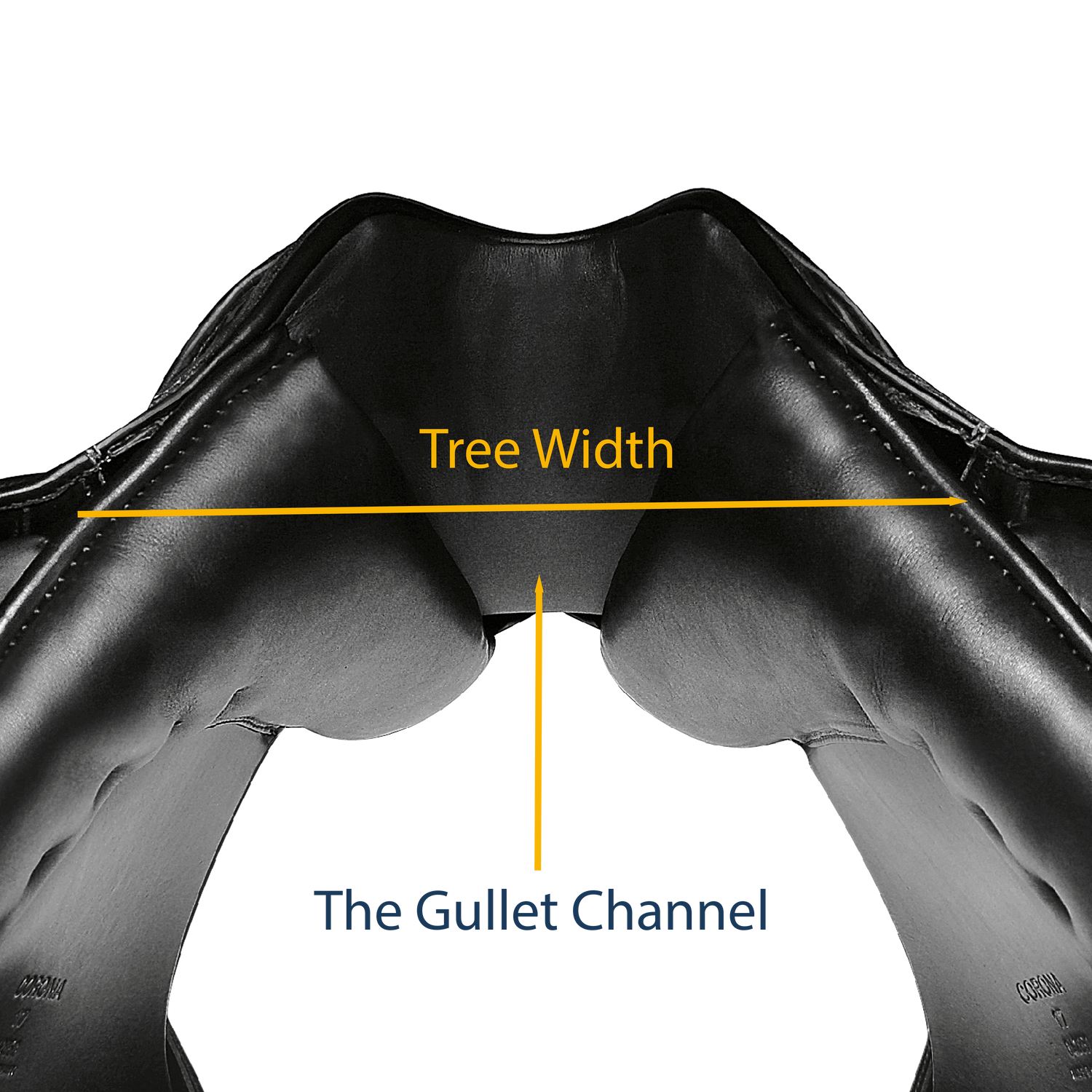
The term tree width is itself a little misleading. What we actually mean when we say tree width is the gullet plate.
In the English-style saddle, the gullet plate is the front structural piece that forms the pommel, determines the width at the shoulder, and incorporates the tree points.
Gullet plates can have different shapes, and the length of the tree points is one of the key differentiators between manufacturers. The tree itself must match the gullet plate it carries. This is part of why different saddles feel distinctly different to both horse and rider, particularly in the front.
The gullet plate — a closer look
Different manufacturers solve the gullet-plate problem differently. As one detailed example, the Passier saddle tree — the PS Baum, still produced at the Hannover workshop — accepts three different gullet plate types depending on horse conformation. This makes it useful here for illustrating how gullet plate shape and width together determine what most riders call “tree width.”

The standard gullet plate — for roughly 85% of horses
For roughly 85% of the horses I fit — from pony to extra-large Warmblood — the standard gullet plate shape provides the right base. Producing the saddle with that shape in the measured width for the particular horse, combined with panel customization, achieves the fit.
Note: The 'tree width' describes the distance between the tips of the tree points. While this can be the same for all three gullet plate types, the TOP of the gullet plate also has a different width between the different types.

The extra-wide gullet plate — for roughly 10% of horses
For roughly 10% of horses — across breeds and sizes — the extra-wide gullet plate is the right fit. The top of this plate is wider, allowing the tree points to descend at a different angle to follow the horse’s shoulder shape.

The FRT system — for the remaining 5%
For the remaining 5%, almost all Lipizzans in my practice, the Passier FRT system uses specially formed tree points to give those breeds the shoulder freedom their conformation requires.

In all three cases the underlying tree is essentially the same; only the pommel section changes to accommodate the gullet plate.
A note on scope: in this chapter, we are narrowing the topic to the tree and gullet plate. There is much more to it. The panels — their cut, height, fill, shape — are an integral part of how a saddle is built and contribute considerably to the fit.
Now to the second misconception: the gullet channel
No saddle can change the fundamental constraint: we sit on the horse’s back, and we must not sit on the horse’s spine. (Skilled bareback riders manage this without a saddle by carrying their weight through their thighs — but they are working with their own bodies as the supporting structure.)
Freedom of movement under the rider means the horse must be able to move his spine through its full range.
And here, in my practice, a second myth surfaces:
A misconception: is a wider gullet channel better?
Knowing that the horse needs spinal clearance, and tending — as humans do — to think that more is better, many horse owners err toward width when choosing a saddle without professional help.
The result is real discomfort, stiffness, and performance problems for the horse. Even if everything else about the saddle is correct, the wrong gullet channel width will undermine every other element of the fit.
What is the gullet channel?
The gullet channel is the space between the two sides of the panel. The panel can be removed from the rest of the saddle — for instance for a complete reflock or replacement. Because panels are made from patterns, much like clothes, it is sometimes possible to change the gullet channel width by altering the panel — and sometimes it is not.
Gullet channel — normal, narrow, and wide
As a rule of thumb for the average horse, a gullet channel width of about four inches is considered medium. Narrower channels are narrow; wider channels are wide.
When we need a narrow channel
Some horses have a roof-shaped back, which requires a specific panel shape and height in combination with a narrower gullet channel. This can apply even to a seventeen-hand athletic Warmblood. A big horse does not automatically need a wide gullet channel.
Back shape is what determines gullet width.
 This horse has a roof-shaped back.
When we need a wide channel
Some horses — at the other end of the spectrum — have a very flat or barrel-shaped back, where the spine does not protrude above the long back muscles. Here, a wider gullet channel combined with a flatter panel shape is appropriate.
 This horse has a rounder back.
Too wide — too narrow — what is the problem?
 Two saddles with medium gullet channels but differing gullet plates.
A saddle panel with a narrow gullet channel.
A horse with a roof-shaped back and a prominent spine — by conformation, not from underweight — will suffer under a too-wide gullet channel, which lowers the tree too close to the spine once the rider is mounted. Pain, rubbing, and stiffness follow.
A too-narrow gullet channel can pinch the spine, producing swelling, pain, and behavioral refusal — among other problems.
How can the rider assess tree width?
The first indicator of correct tree width is saddle balance.
- Place the saddle on the horse without a pad, girth it up to hold it in place, and observe the saddle from the side.
- The deepest point should sit at the center of the seat. If it does not, tree width may be the reason.
How can the rider assess gullet channel width?
Measure across the center of the channel.
Is it at, below, or above four inches? Now look at the back shape of your horse. The two pieces of information together — measurement and conformation — are what tell you whether the channel is right.
In either case, if you observe a mismatch, work with a knowledgeable fitter — preferably one who specializes in your saddle’s brand.
For first questions, and to learn whether a custom fitting is the right next step for you, schedule your free 15-minute Discovery Call.
Book your Discovery CallI look forward to speaking with you.
If you’d rather put your questions in writing first, fill out our Saddle Fit Questionnaire and I’ll review it and send you expert input on where to start.
Fill out the Saddle Fit Questionnaire →About the Author

Stefanie Reinhold is the founder of HorseHaus and a certified Passier® saddle fitter, certified Herm Sprenger® bit fitter, Masterson Method® practitioner, and clinician. She is the co-author and translator of multiple equestrian books. She conducts in-person and virtual saddle fittings across the United States.
HorseHaus — For horses. From horse people.
horsehaus.com