
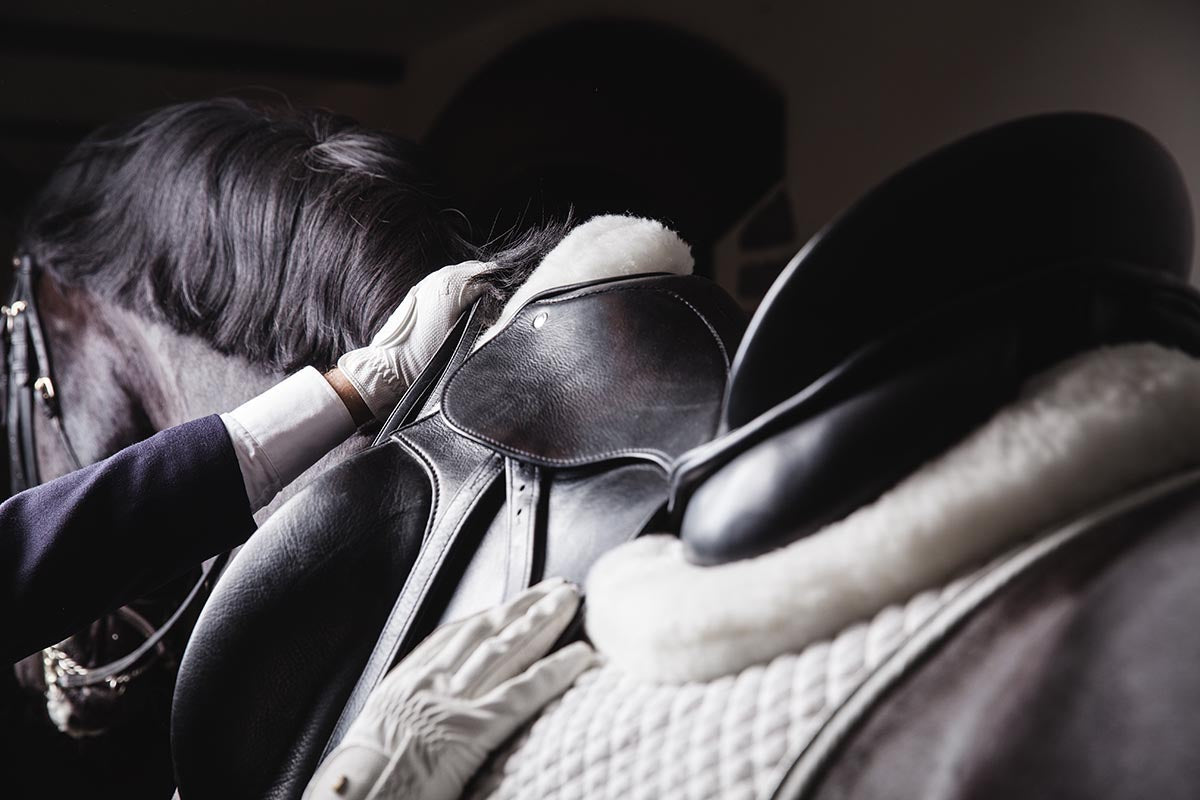
"Ideally, horse and rider move together in harmony..." — read the full Saddle Fitting Guide introduction here.
In the previous article in this series, we established why saddle fit knowledge belongs to every horse owner — not to replace your fitter, but to help you recognize what you're seeing and ask better questions. Before we can talk about what a well-fitting saddle looks like, we need to understand what it is fitting.
That begins with your horse's back.
Understanding horse back anatomy and saddle fit is the foundation of every saddle fit evaluation — and it is knowledge every horse owner can develop. No two horses carry the same back. The shape, length, balance, and structure of your horse's topline are as individual as a fingerprint — and unlike a fingerprint, they change over time. Body condition, training, schooling level, and age all influence the back your saddle sits on.
By the end of this article, you will be able to identify the five basic parameters that define your horse's unique back landscape — and complete a practical assessment of your own horse.
Five Parameters, One Unique Back Landscape
Every horse shares the same basic anatomy. What makes saddle fitting complex is not anatomy itself — it is the infinite variation within that anatomy. Five fundamental parameters combine to create what I call your horse's back landscape: the unique shape that a saddle must fit.

1. Wither Shape
- Height — high, medium, or low
- Length — long or short
- Width — narrow or broad
2. Back Surface Shape
- Roof-shaped — spine or spinal ligament is the highest point
- Flat — spine sits level with or below the long back muscles
- Everything in between — which is most horses
3. Back Length
- Short
- Medium
- Long
Note: back length in saddle fitting refers specifically to the weight-bearing area — explained in detail below.
4. Croup Height
- Croup higher than withers
- Level
- Croup lower than withers
5. Girth Groove Position
- Forward — close behind the elbow
- Neutral — approximately one hand's width behind the elbow
- Backward — further toward the flank
The Math — Why "My Horse Is a Medium" Is Never Enough
Here is a useful thought experiment. If each of these five parameters had only three variations — a significant underestimate — the number of possible combinations is:
3 × 3 × 3 × 3 × 3 = 243
243 possible unique back landscapes — at minimum.
In practice, each parameter includes far more than three variations. The real number of possible combinations runs into the thousands.
This is why saddle fitting cannot be standardized. A horse's back is not a size. It is a combination of multiple interacting structures that must be evaluated individually. When a saddle salesperson tells you your horse is "a medium tree" based on a quick glance, they are collapsing thousands of possible combinations into a single category. That is not fitting. It is guessing.
Key point: True saddle fitting is not based on templates or assumptions. It is a structured evaluation of how shape, balance, and biomechanics come together in your individual horse.
The Five Parameters in Detail
1. The Withers

The withers are the spinous processes of the 2nd through 10th thoracic vertebrae — the bony prominences that form the highest point of the horse's back behind the neck. Many riders know them primarily as an inconvenience when fitting a saddle, but they are far more significant than that.

Think of the withers not as static structure but as a lever system. They are connected to the vertebrae of the spine, and pressure or movement in the wither region has a direct effect on the rest of the back. This is why wither clearance — the space between the saddle and the top of the withers — is one of the most critical saddle fit parameters.
For saddle fit, we consider three wither characteristics:
- Height — the difference between the highest point of the withers and the lowest point of the back. A pronounced wither provides more stability for the saddle. A flat or mutton wither offers less purchase and is one of the more challenging fitting scenarios.
- Slope — how far the withers extend into the rider's seat area. A long slope requires more clearance further back in the saddle.
- Width — how much space the saddle must provide to clear the withers from left to right. This directly influences tree width.
The withers are largely determined by genetics. That said, they can appear higher or lower depending on the horse's body condition and muscle development — which is one of the reasons saddle fit must be reassessed as the horse's condition changes. In Passier® saddle fitting, wither assessment is always the first step — no other measurement is meaningful until the wither shape and clearance requirements are understood.
2. The Back Surface Shape
If you could take a cross-section of your horse's body at the saddle area, what shape would you see? This is the back surface shape, and it has a direct influence on how panels must be shaped and angled to make full, even contact with the horse's back.

In a roof-shaped back, the ribs slope downward from the spine and the spinous ligament is the highest point of the back surface. The panels of a well-fitting saddle must follow this angle. If the gullet channel is too wide on a roof-shaped horse, the saddle drops down and sits directly on the spine — one of the most common and damaging fitting errors.

In a flat back, more common in draft breeds and some ponies, the spine may actually sit level with or even below the long back muscles. Imagine placing a tray on top — it would sit relatively level. The panel angle required for this horse is entirely different from the roof-shaped horse.
Most horses fall somewhere between these two extremes, with considerable variation within that range. An educated fitter will also assess the angle at which the ribs spring outward from the spine, and whether the back surface is concave or convex in other planes. For now, developing your eye for roof-shaped versus flat is the important first step.
3. Back Length — and the Significance of T18

When we speak of back length in the context of saddle fit, we are not talking about the overall length of the horse's topline. We are talking specifically about the weight-bearing area — the region that can safely carry the load of a saddle and rider.

This weight-bearing area runs from behind the rear edge of the shoulder blade to T18 — the last thoracic vertebra that has a rib attached. T18 matters because behind it, the horse's back becomes structurally different. The lumbar vertebrae lack the lateral support of the ribs, making them significantly more vulnerable to compression. The thoracolumbar junction and the lumbosacral joint are the most biomechanically sensitive areas of the horse's back. A saddle that extends beyond T18 is loading structures that are not designed to carry weight.
Some horses appear long-backed but actually have a short weight-bearing area and a long lumbar. This is common in Thoroughbreds, some Spanish breeds, Dutch Harness Horses, and Saddlebreds. In these horses, the usable saddle length is considerably shorter than the horse's overall topline would suggest.
How to locate T18: Place your hand on your horse's last rib and follow it upward toward the spine. Where it meets the spine is T18 — the posterior boundary of the weight-bearing area. Mark this point lightly and assess the length available from behind the scapula to T18. This is the space your saddle must fit within.
4. Croup Height
Stand back and look at your horse from the side. Is the croup — the highest point of the hindquarters — higher than the withers, level with them, or lower? This relationship has a direct effect on how a saddle sits and how the rider is positioned.
A croup-high horse, common in younger horses still developing behind, tends to tilt the saddle forward, pitching the rider onto the pommel. A croup-low horse does the opposite. Neither is inherently wrong conformationally, but both create fitting challenges that must be addressed. The goal in saddle fitting is always to place the rider in a balanced, neutral position regardless of the horse's natural balance.
A special and more complex case is the roach-backed horse — a horse with an upward curve in the lumbar region. This requires specific fitting considerations that go beyond the scope of this article.
5. Girth Groove Position

The girth groove is the natural depression in the horse's barrel where the girth wants to sit. Most riders think of girth fit as a separate topic from saddle fit — in reality, they are inseparable.
The billets of a well-fitting saddle must hang as perpendicular to the ground as possible. When they do not — because the girth groove position forces the girth forward or backward — the saddle is pulled out of its intended position and uneven pressure results in the panels.
A forward girth groove, where the belly begins to descend almost immediately behind the elbow, is one of the more challenging fitting scenarios. It often requires a specific billet configuration in the saddle and a specially shaped girth to compensate. A backward girth groove is less common but presents its own challenges.
Girth groove position is frequently overlooked in saddle fitting discussions. Do not underestimate its influence on overall saddle balance.
Your Horse's Back Is Not Fixed
Important: An ill-fitting saddle can negatively alter your horse's back over time — causing chronically contracted topline muscles, hard spots, dips behind the shoulder blade, and asymmetry. The basic shape of your horse's back is largely determined by genetics. What happens to that shape under a poorly fitting saddle is not.
Beyond saddle-related changes, the back you are fitting today is not necessarily the back you will be fitting in six months. Four factors influence your horse's back shape over time:
- Body condition — weight gain or loss changes the soft tissue coverage over bony landmarks
- Training condition — a fit, well-muscled horse carries a different back than a horse in light work
- Schooling level — a horse working correctly through his back over time develops differently than one who is not
- Age — the back of a 5-year-old and a 20-year-old are genuinely different landscapes
This is why saddle fit is not a one-time event. It is an ongoing assessment. A saddle that fits well today deserves a check in six months — and certainly after any significant change in the horse's condition or work.
Practical Exercise: Get to Know Your Horse's Back

This is the exercise that makes the theory real. Set aside 20 minutes at the barn, bring your phone for photos, and work through each step with your hands and your eyes.
Step 1 — Photograph your horse
Take photos from the following angles. You will refer back to these as you work through the rest of this series.
- Directly from the left side
- Directly from the right side
- From the left hip toward the right shoulder (diagonal)
- From the right hip toward the left shoulder (diagonal)
Step 2 — Assess each parameter
Work through the five parameters as best you can. You are developing your eye, not making a definitive diagnosis. Feeling and observing is the goal.
- Withers — Are they high, medium, or flat? Long or short in slope? Narrow or broad?
- Back surface shape — Look at your horse from behind at back level. Roof-shaped, flat, or somewhere in between?
- Back length — Place your hand on the last rib and follow it up to the spine to locate T18. How long is the weight-bearing area from behind the scapula to T18?
- Croup height — Stand back and look from the side. Is the croup higher, level with, or lower than the withers?
- Girth groove position — Where does the girth naturally want to sit? Close behind the elbow, approximately one hand's width back, or further toward the flank?
A note on 'normal'
In this context, normal means what a sport horse with balanced conformation typically presents. 'Not normal' does not mean 'not good' — it means different needs. A flat-withered cob and a high-withered Warmblood are both wonderful horses. They simply require different solutions.
Stay patient with yourself as you work through this. These observations take time to develop. The more horses you observe — at the barn, at shows, in photographs — the faster your eye will improve. Every horse you look at is a learning opportunity.
What Comes Next
Now that you understand the five parameters that define your horse's unique back landscape, the next article in this series will show you how a saddle must respond to each of them. The 5 Key Parameters of Saddle Fit — a practical checklist takes everything in this article and connects it directly to what you look for in a well-fitting saddle.
Wondering whether your current saddle fits your horse's back correctly? A free 15-minute Saddle Fit Discovery Call is a good place to start — no obligation, just a conversation with a certified Passier® fitter.
→ Book your free Saddle Fit Discovery Call
→ Learn about our Virtual Saddle Fitting Service
→ Back to the Saddle Fitting Guide hub
Stefanie Reinhold is the founder of HorseHaus™ and a certified Passier® saddle fitter, certified Herm Sprenger® bit fitter, Masterson Method® practitioner, clinician, and co-author and translator of multiple equestrian books. She conducts in-person and virtual saddle fittings across the United States.
HorseHaus™ — For horses. From horse people. — horsehaus.com